

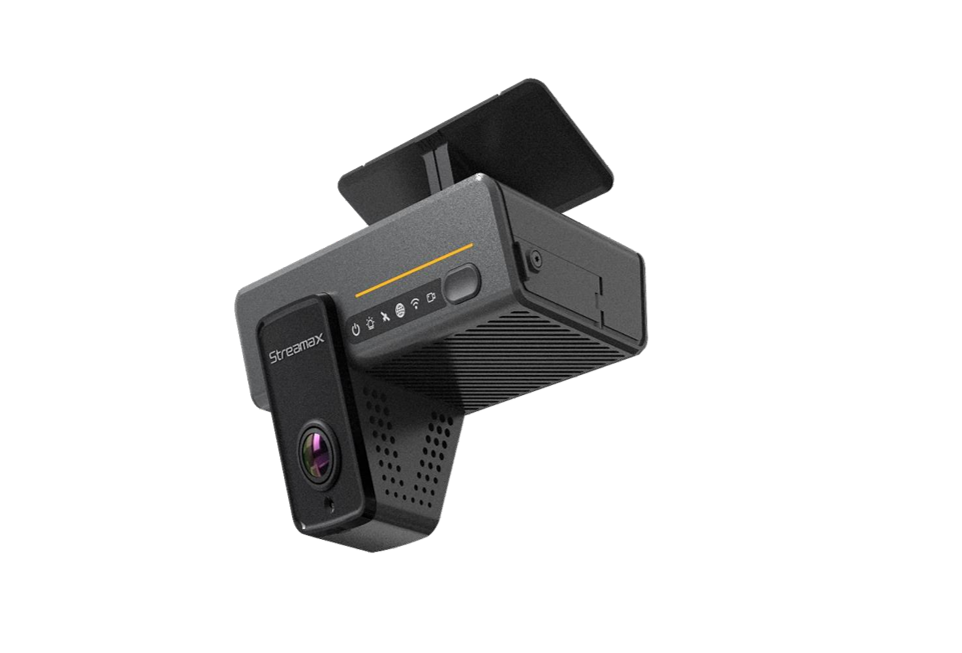
Ultra-wide 140° DFOV road facing lens, supporting up to 1920P UHD video recording .Ultra-wide 170° DFOV driver facing lens, supporting up to 1080P HD video recording .Support up to 4-channel video recording .Built-in Wi-Fi, 4G communication module, and inertial navigation positioning module .Supports 2x256GB dual-Micro SD card storage.
Functions
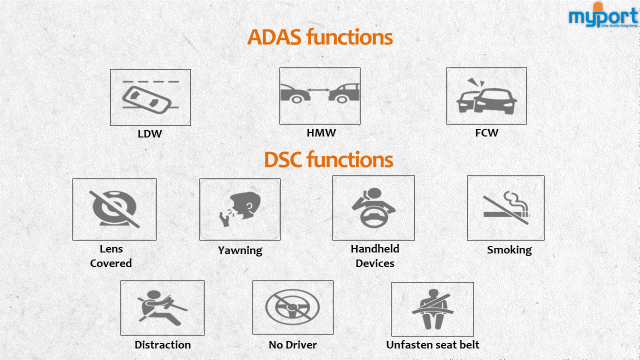
Features
- 5MP resolution with 140° DFOV for ADAS, 1080P resolution with 170° DFOV for DSC
- Support up to 4-channel video recording, H.264/H.265 video coding
- Dual Micro 256G SD card storage, supporting dual-stream recording
- Built-in Wi-Fi and 4G module
- Support 4-channel I/O input, 1 channel CAN and 1 channel RS232
- Compact Design
- Support OBD powering, easy installation
- Functions of built-in ADAS and DSC, supporting AI event detection (up to 2-channel)
- Support sleep mode, remote wake-up(power consumption less than 0.1W)
- Support echo suppression algorithm to improve the quality of two-way voice intercom
- 6-axis gravity sensor detects intense driving behaviors (Harsh Acceleration, Deceleration, Sharp turn & Accident detection)
FAQs
An AI-powered driver state monitoring device, often called a DMS camera, uses onboard AI to watch both the road and the driver simultaneously, detecting fatigue, distraction, and unsafe driving behavior in real time to reduce accidents caused by reduced driver awareness.
It uses a dual-lens design: an ultra-wide 140° road-facing lens recording up to 1920P UHD for ADAS (Advanced Driver Assistance System) functions, and a 170° driver-facing lens recording up to 1080P HD for DSC (Driver State Monitoring) functions.
Yes, it supports dual Micro SD card storage of up to 256GB each, with dual-stream recording across up to 4 video channels, so both road-facing and driver-facing footage can be reviewed later.
Yes, it has a built-in Wi-Fi and 4G communication module along with inertial navigation positioning, allowing live location tracking and remote access to alerts or footage without manually retrieving the SD cards.
It supports OBD powering for straightforward installation, connecting directly to the vehicle’s OBD port rather than requiring complex custom wiring, which shortens fitment time for fleet vehicles.
Yes, it includes an echo suppression algorithm that improves the quality of two-way voice intercom, allowing fleet supervisors or safety officers to communicate directly with the driver when an alert is triggered.
Given the volume of searches around driver monitoring systems in India, fleets are increasingly adopting AI-based DSC and ADAS devices to proactively catch fatigue, distraction, and risky driving patterns before they lead to accidents, rather than only reviewing incidents after they happen.