

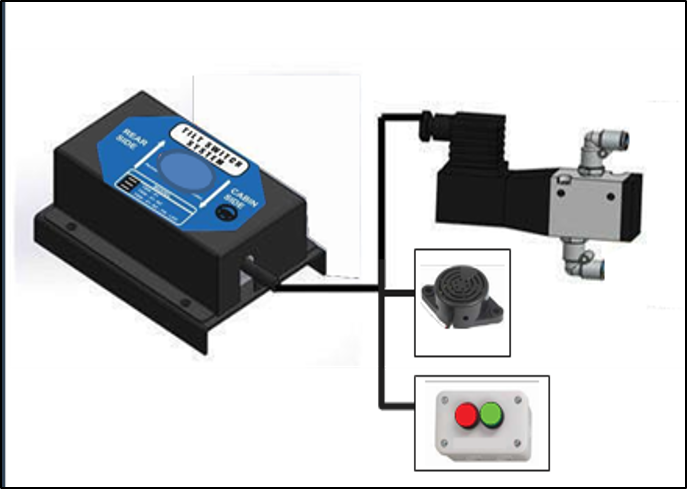
TSW-01 is a dual-axis, compact and robust industrial grade tilt switch. It can be used in static and harsh environments as factories, automotive or construction sites. The system provides an output when the vehicle angle is more than the set limit. The output is used to stop tipping of the vehicle for safety purpose. Visual and audio indication is ON when the vehicle angle is more than set point during tipping to alert the operator.
Features
- Dual axis angle measurement (±70°) Digital output
- Quick response
- Robust design
- Plug & Play installation
- Visual and audio indication to alert the operator PC application interface
- Configurable set limit
FAQs
An anti-tilt switch, such as the TSW-01, is a dual-axis industrial-grade tilt sensor that continuously monitors a vehicle’s angle. When the tilt exceeds a pre-set safe limit, the anti-tilt system sends a digital output that stops further tipping and triggers a visual and audio alert to warn the operator before a rollover occurs.
The TSW-01 offers dual-axis angle measurement up to ±70°, giving it a wide detection range suitable for construction, mining, and port vehicles where tilt tolerances vary depending on terrain and vehicle type.
Yes. The anti-tilt switch is built with a robust, compact design specifically for harsh environments like factories, automotive plants, and construction sites, where dust, vibration, and rough handling are common.
The anti-tilt switch supports plug-and-play installation, meaning it can be mounted and wired into existing vehicle systems without complex modifications, minimizing equipment downtime during setup.
Yes, the anti-tilt switch features a configurable set limit, allowing operators to adjust the safe tilt threshold based on the specific vehicle type, load, and operating terrain.
The anti-tilt switch is designed for quick response, detecting unsafe angles and triggering the digital output almost instantly, which is critical for preventing rollover during fast-moving tipping operations.
Anti-tilt switches are widely used across ports, mining sites, construction sites, and automotive manufacturing, anywhere dumpers, tippers, and heavy vehicles operate on uneven surfaces and face rollover risk during loading or unloading.